Platform Modernization at Enterprise Scale
Category
Platform Leadership
/
Design leadership, governance, and institutional knowledge for a 24-month, $25M modernization effort consolidating multiple consumer product suites onto a next-generation enterprise platform.

Modernizing Without Losing Momentum
TransUnion’s consumer identity-protection business needed to move several established product experiences onto a new enterprise platform without disrupting customers, partners, or the teams supporting them. The work spanned multiple brands, legacy assumptions, regulatory constraints, and a long tail of user journeys that had accumulated over years of product growth.
My role centered on design leadership for the modernization effort: translating institutional knowledge into platform-ready decisions, helping teams reduce ambiguity, and making sure the migration improved the experience rather than simply recreating old flows in a new system.
From Legacy Products
to a Shared Platform Model
The challenge was not just interface redesign. It required aligning product, engineering, compliance, content, and operations around a shared understanding of what each experience needed to become. I helped define how existing journeys should map into the new platform, where patterns could be standardized, and where business or customer needs required more intentional exceptions.


Clarifying the Migration Strategy
At enterprise scale, the riskiest parts of modernization are often the least visible: undocumented edge cases, partner-specific behavior, operational dependencies, and small decisions that have become load-bearing over time. I worked across teams to surface those details early and turn them into design inputs rather than late-stage surprises.
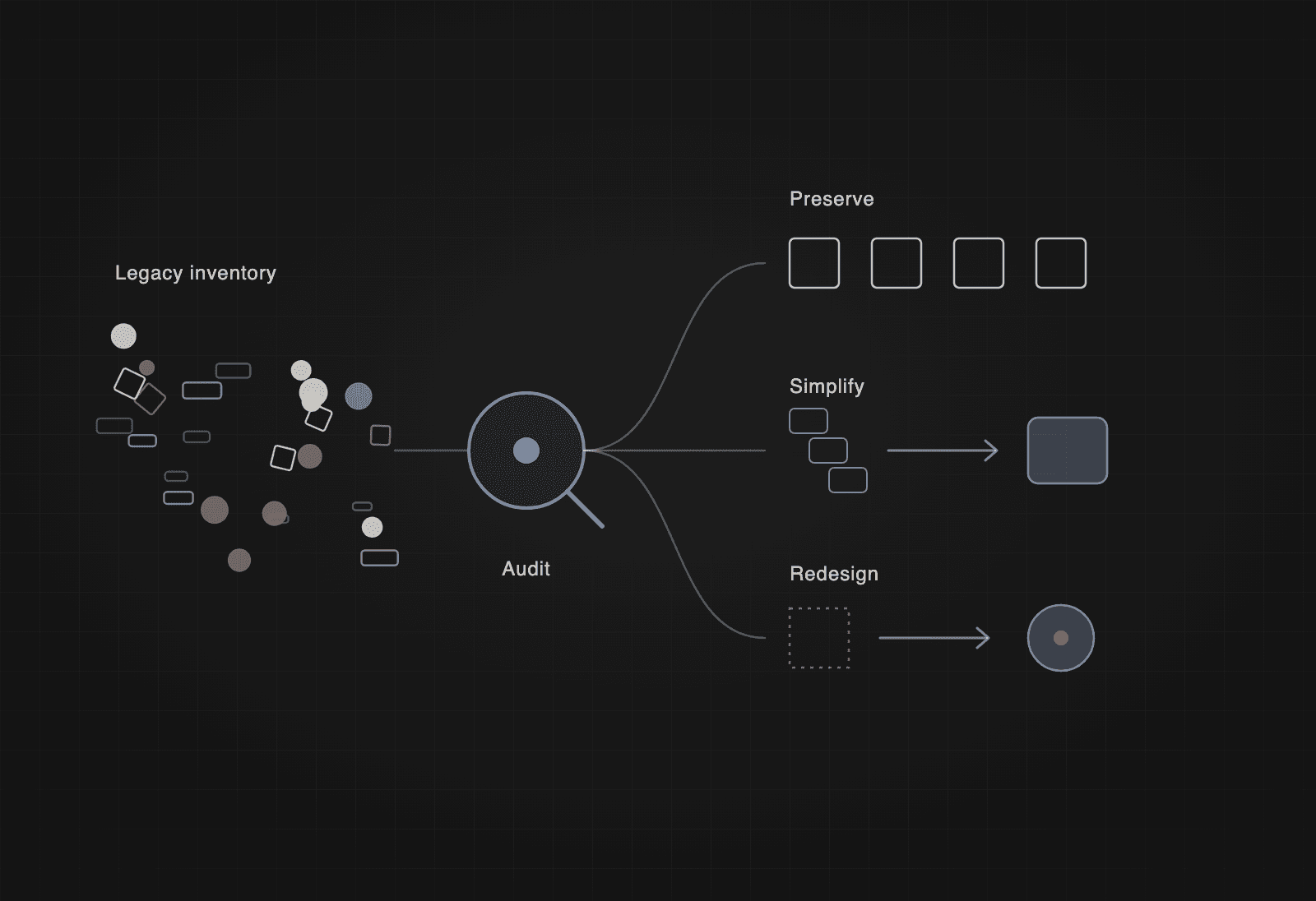
That meant auditing existing experiences, documenting decision points, identifying reusable patterns, and helping stakeholders distinguish between what needed to be preserved, what could be simplified, and what should be redesigned for the new platform.
Design Governance Across Workstreams
The program involved parallel workstreams moving at different speeds. To keep the experience coherent, I supported design governance through shared UX principles, platform pattern alignment, review rituals, and documentation that gave teams a common language for decisions.
This helped reduce rework, created clearer handoffs, and gave product and engineering partners confidence that individual feature decisions were contributing to a consistent platform experience.
Balancing Consistency with Product Reality
A modernization program can easily over-standardize. Part of the work was knowing where consistency created value and where a product, partner, or compliance requirement needed a more specific solution. I helped teams evaluate those tradeoffs through the lens of customer comprehension, operational feasibility, and long-term maintainability.
The result was a platform direction that respected the realities of the business while still moving the experience toward a more unified, scalable foundation.
A More Durable Product Foundation
The modernization effort created a clearer path for consolidating consumer experiences onto the new platform while preserving the knowledge embedded in the legacy ecosystem. Design became a connective layer between strategy, product requirements, technical constraints, and the customer experience.
Leadership Through Ambiguity
My contribution was helping the organization make better decisions in the messy middle of transformation — where the work is too complex for simple redesign, too important for shortcuts, and too interconnected for any one team to solve alone. The value came from creating clarity, reducing risk, and keeping the user experience visible throughout a large-scale platform shift.

